
Hair in our society is often a very important aspect of our lives. It is something that characterizes us and defines us. It’s something babies are born with and animals even possess. Sometimes our hair is characterized by the color, style, length, lack-there-of, or in this case uniqueness of. The following article that I came across on my internet browser, MSN, talks about a young girl who has distinctive hair traits. The Lifestyle and Health section of MSN News speaks of a girl named Shilah who has a hair condition called Uncombable Hair Syndrome. Apparently the condition involves a difference in the hair shaft and the shape of the hair bulb that causes the hair to grow differently than most. Individuals with Uncombable Hair Syndrome often have light colored hair that grows outward and frizzy rather than downward and smooth. Readers may stumble across this article through their internet browser if it is connected to a news outlet, browsing the MSN website, on social media, on a parent website discussing different issues, or a dermatology website that links to this article.
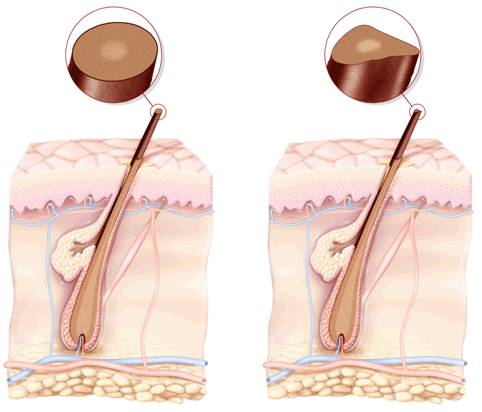
Within this article and through MSN’s research with Genetics Home Reference, they claim that “Uncombable Syndrome is extremely rare, there are just 100 cases of it in scientific literature— and it typically first becomes apparent between the ages of 3 months and 12 years.” This led me to want to further analyze how rare this syndrome is (100 cases) and if the ages listed hold any truth. I asked the following questions to begin my search: How rare is Uncombable Hair Syndrome? What age is it typically diagnosed? Now I can transition to move one to analyze my questions further.
First, I went to the search engine Duckduckgo and typed in the name of the syndrome and searched through snopes and factcheck.org, nothing was found. I also took the quote that I am focusing on, placed it in quotes and searched it on Duckduckgo and no results were found. Next, I traveled over to Wikipedia and was able to find an article pertaining to the hair disorder. The Wiki site confirms the age information that the MSN article gives. According to their research with the National Institute of Health, “…the condition tends to develop in childhood (ages 3-12) and resolve by adolescence”(Wiki). There wasn’t any information on how rare the case is but just a statement that it is in fact a rare disorder “a rare structural anomaly of the hair…”(Wiki) For move one, I wasn’t able to find a large quantity of information to clarify the statement that I am fact-checking. In order to gain further information, I moved on to move two. In reading the Wikipedia article, I noticed their references at the bottom of the article in the footnotes section. First, I clicked on a link for an article that’s name looked familiar to me. The footnote article was titled Girl With Uncombable Hair Syndrome Rocks Her Rare Condition With Style and is from the website Parents.com. I realized that the name of that article was mentioned in the initial article that I am fact-checking because they included one of their videos on the subject matter. Even though Parents.com isn’t really a reputable source, this connection was helpful because I know that this syndrome was researched before and had a previous source. Another footnote on Wikipedia links to a portal called Orphanet that has information on rare diseases. This portal defines the syndrome as “Uncombable Hair Syndrome (UHS),…, is a rare scalp hair shaft dysplasia”(Orphanet). They also state that the “age of onset is childhood” and further down the page indicate ages three months to twelve years old. All of this information supports the initial claims in the MSN article. Digging further into the information on UHS on Orphanet, I clicked on a link titled “other websites” and that led me to a platform called Genetic and Rare Disease Center (GARD). On GARD I found similar information on the common age of diagnosis as well as it’s rarity. Doctors have found that it is a rare genetic disorder that can only be passed on through the genes and sometimes skips a generation. If there aren’t many individuals with Uncombable Hair Syndrome, then one can assume there are few children that the gene is getting passed on to. While reading the information on the GARD website, I found under the title “learn more” a link to another website called Genetics Home Reference (GHR). GHR is updated by the National Library of Medicine and as quoted earlier, this database was where the MSN article received their frequency rate on how rare the disorder is. This means that I went full circle on fact-checking this information and that the sources who claimed these numbers were credible. No other site besides GHR was able to produce an actual number on how rare UHS is but each site validated the age of onset.
 Eva's Wonders of Writing